
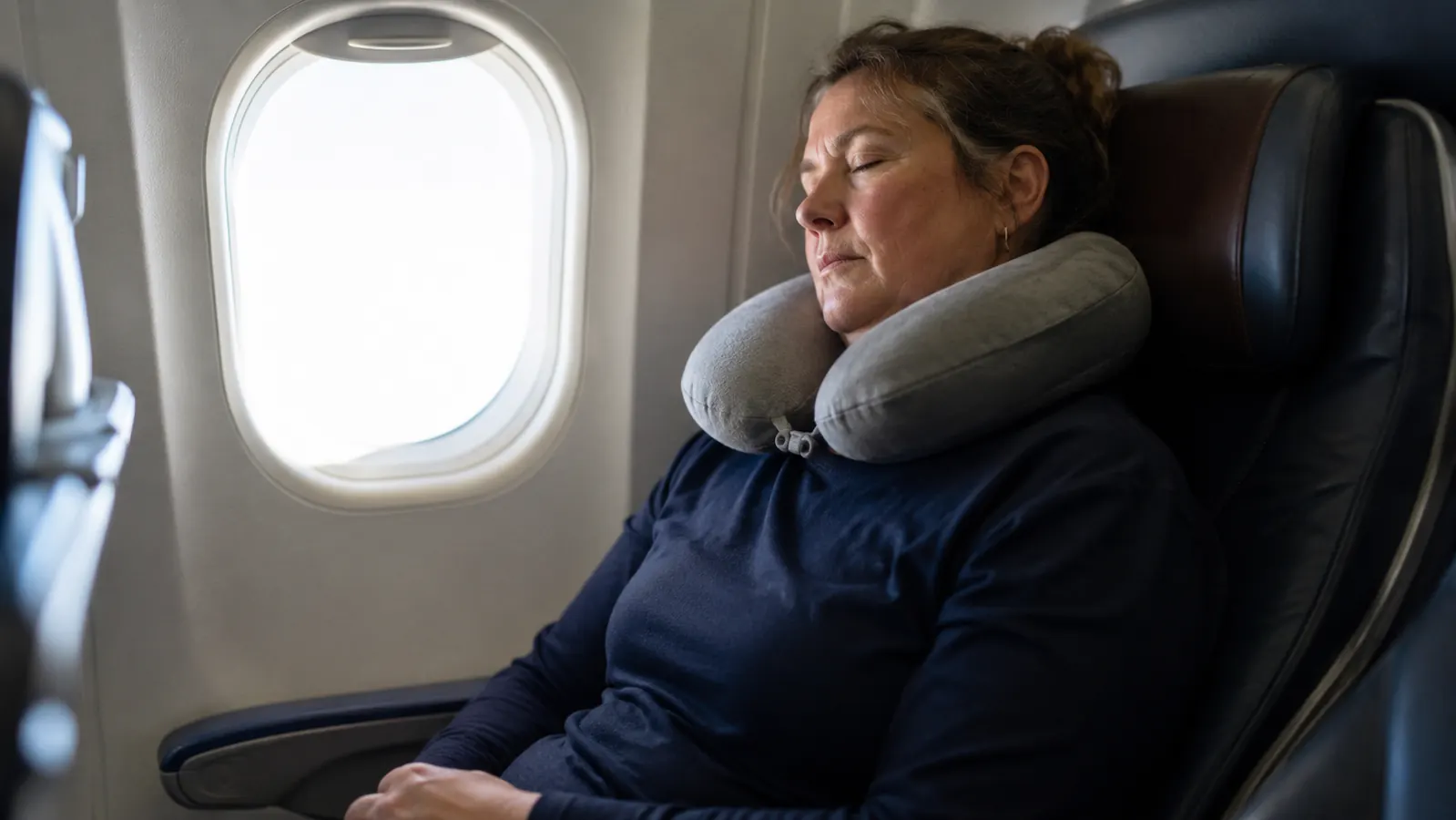
A year ago I flew to Denver for my sister's retirement party, landed with a neck so stiff I couldn't turn my head to check my blind spot on the rental car drive, and lost the first morning of what was supposed to be a three-day trip to a heating pad and ibuprofen instead of the hike we'd planned. That was the trip that finally got me to buy an MLVOC travel neck pillow, the memory foam kind that comes bundled with an eye mask and earplugs in one drawstring pouch. I'm 52, I hike most weekends with my dog Scout when I'm home, and I travel enough between flights to see family and long drives to trailheads that a wrecked first morning isn't a minor annoyance anymore. It's the day of the trip I don't get back.
I'd resisted neck pillows for years, mostly because the inflatable ones I'd tried on earlier trips always felt like sleeping against a beach ball, slipping sideways the second my head got heavy. The MLVOC pillow is solid memory foam shaped like a horseshoe, dense enough to hold its shape but soft enough that it doesn't dig into my jaw. A year in, fourteen flights and three long road trips to campsites later, here's what actually happened.
The Quick Verdict
A genuinely effective travel recovery tool that keeps my neck from locking up on flights and long drives, which means I actually show up for the first morning of a trip instead of nursing it. The included eye mask is mediocre, but the pillow itself has earned a permanent spot in my daypack.
Amazon Check Today's Price →The First Morning of Your Trip Shouldn't Be a Write-Off
If a stiff neck from the flight or the drive has ever cost you the first day of a trip, this is the three-in-one kit I now pack every single time.
Amazon Check Today's Price on Amazon →How I've Used It
My use case for the MLVOC pillow splits into two categories: flights and long drives. On flights, I loop it around my neck the second I sit down, before the seatbelt sign even goes off, so it's already broken in and warm from body heat by the time I actually want to doze off somewhere over Kansas. On road trips to campsites, I use it in the passenger seat on legs longer than about two hours, or I let it ride in the back for whoever's not driving.
The eye mask and earplugs live in the same little zippered pouch that came with the MLVOC set, which is a small detail that's mattered more than I expected. I used to dig through a backpack pocket looking for earplugs while a toddler three rows up screamed through takeoff. Now it's all in one place, clipped to the outside of my daypack where I can grab it without unzipping anything.
The one habit I had to build was actually using it on drives, not just flights. My instinct on a road trip is to power through and deal with the stiffness at the destination. Somewhere around month three I started making myself use the pillow on any drive over three hours, propped against the window, and that's when the real difference showed up.
What's Actually Inside the Kit
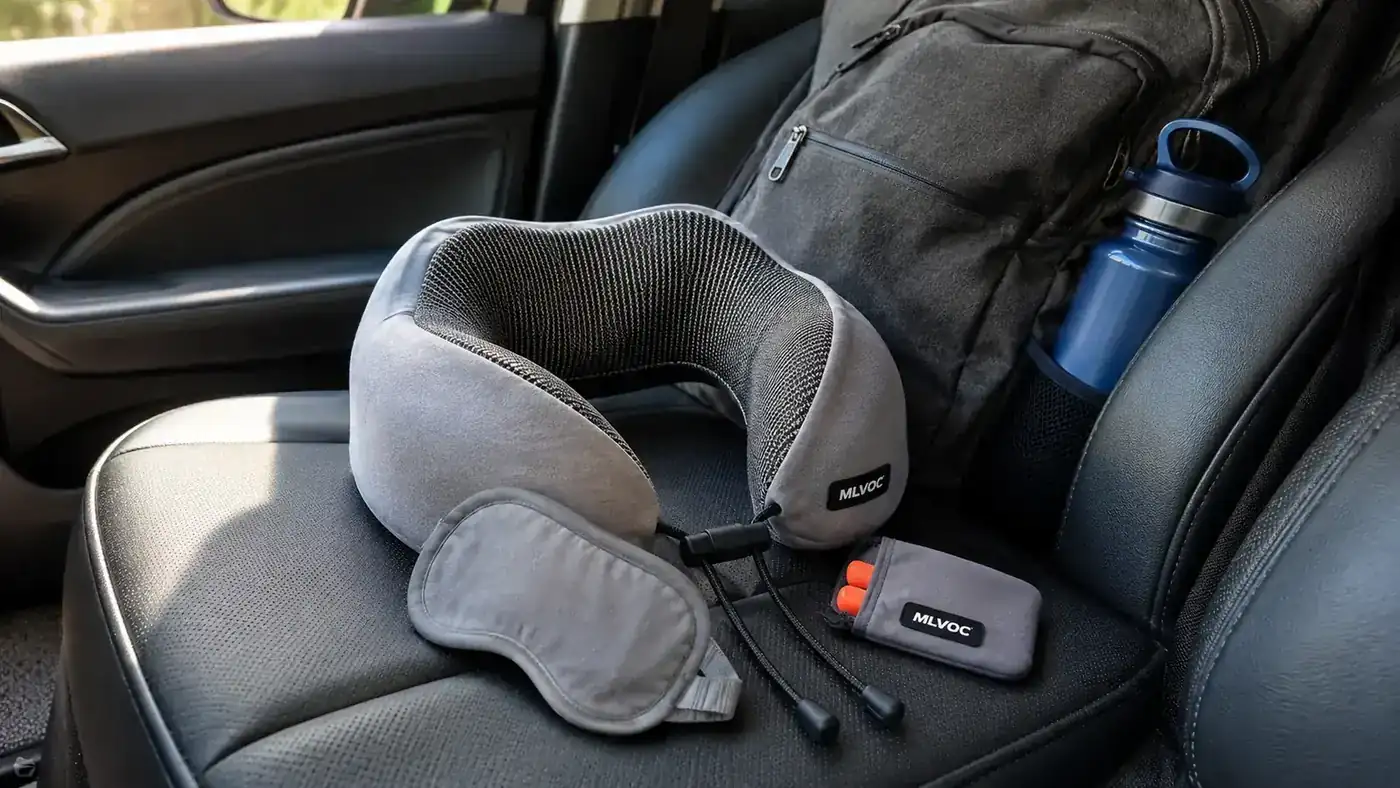
The pillow itself is memory foam wrapped in a soft, slightly stretchy cover that's removable and machine washable, which matters more after a year than it did on day one. It holds its horseshoe shape well, springing back within a few seconds after being compressed in a packed bag, and it hasn't gone flat or lumpy the way a cheaper foam pillow tends to after repeated compression in luggage.
MLVOC includes a snap button and a clip strap on the pillow itself, so it can hook onto a rolling bag handle or stay closed as a loop when it's not around your neck. I use the clip strap constantly, it's the difference between a pillow that dangles off my daypack strap and one that actually stays put through a terminal sprint.
The eye mask is the weakest part of the three-piece set. It's a basic contoured foam mask, fine for blocking light on a red-eye but not something I'd praise on its own. I actually switched to a different eye mask after about two months and just kept using the MLVOC neck pillow and earplugs. The earplugs, foam and disposable, work exactly as expected and I've gone through a few pairs over the year without complaint.
A Year of Flights and Long Drives to Trailheads
Fourteen flights is a real number I tracked, mostly visiting my sister in Denver and my husband's family in Phoenix, plus two work trips. On the flights where I used the MLVOC pillow the whole time, I landed with my neck loose enough to actually turn and check traffic without wincing. On the two flights early on where I forgot to pack it, checked luggage mishap, I noticed the difference within an hour of landing, both times.
The bigger test came on the road trips. A nine-hour drive to a campsite in the Sawtooths last August is the one I keep coming back to when people ask if this thing is actually worth packing. I used the pillow for the last four hours of the drive, propped against the window while my husband drove, and got out of the car ready to set up camp instead of needing an hour on a camp chair first.
Compare that to a similar drive the previous year, no neck pillow, where I spent the first evening at camp rubbing my own neck and skipped the short evening walk Scout and I usually do to scope out the trailhead for the next morning. That's the actual cost of a stiff neck from travel, it's not the discomfort itself, it's the activity you quietly opt out of because your body is telling you to sit still.
Why a Stiff Neck Costs You the Next Morning
This is the part that took me longer to connect than it should have. A stiff neck from six hours in an upright airplane seat, or four hours slumped against a car window without support, doesn't stay in your neck. It travels into your shoulders and upper back overnight, and by morning it's the reason you're moving slower on the first mile of a hike, or why you decide the shorter loop is fine instead of the one you actually planned.
The MLVOC pillow's job, as far as I'm concerned, isn't to make the flight or the drive more comfortable in the moment, though it does that too. It's to protect the next morning. On trips where I've used it consistently, I show up at the trailhead the same person who left home, not someone who needs the first hour to loosen up before the trip actually starts.
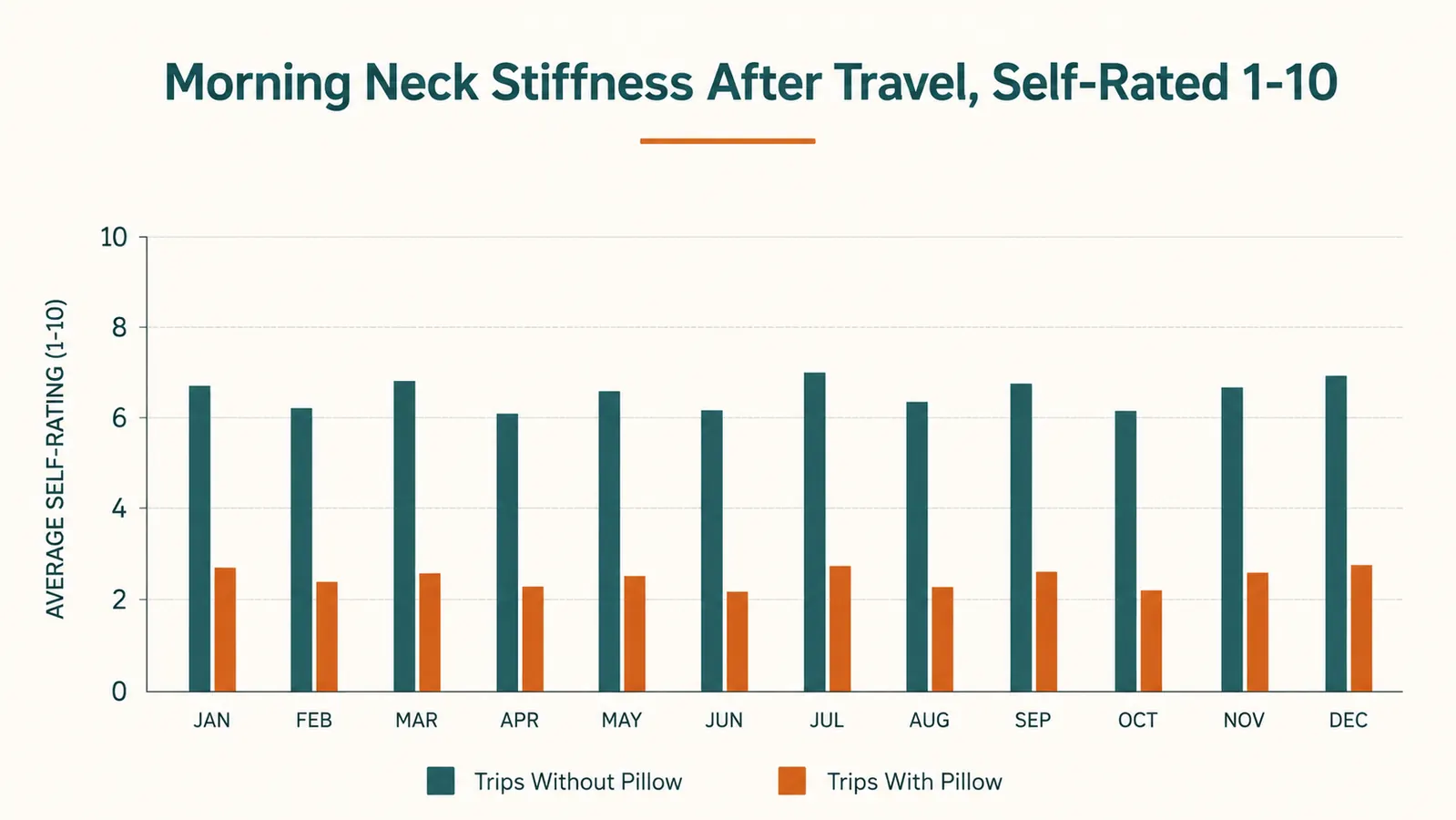
I started keeping loose notes comparing how my neck and shoulders felt the morning after travel, with the pillow versus without, going back through the year. The pattern held every time I checked it honestly: trips with the pillow, I rated morning stiffness low, usually a two or three out of ten. Trips without it, especially longer flights or drives, I was consistently rating it a six or higher.
Where It Falls Short
The horseshoe shape that works so well upright doesn't do much for me lying flat, which matters if you're the type who reclines the seat back or stretches out across a back seat on a road trip. I've tried using it as a lumbar support in that position and it's not built for it, it just slides around. It's a neck pillow for sitting upright, full stop, and it should be judged on that job alone.
It's also warmer against the skin than I expected in summer. On an August flight with a broken cabin air vent, I noticed the memory foam holding heat against my neck in a way that got uncomfortable by hour three. That's not unique to MLVOC, most memory foam pillows do this, but it's worth knowing if you run hot or you're flying somewhere without reliable air conditioning.
How It's Held Up After a Year
I run the cover through the wash roughly once a month, more often in summer, and it's held its color and shape through every cycle so far. No pilling on the fabric, no seams pulling loose at the corners, which is more than I can say for a cheaper travel pillow I owned years ago that started shedding foam crumbs after about eight washes. The MLVOC cover goes back on easily too, no fighting a zipper that's slightly too small for the foam insert.
The foam core itself is the real test of a year of hard use. It's been crushed into the bottom of a rolling bag, sat on by accident more than once, and clipped to the outside of a daypack through airport security lines and rental car trunks. It still springs back to its full horseshoe shape within a few seconds of coming out of a bag, no permanent dent where my neck rests most, no soft spot that's developed over time the way I half expected by month six.
The one piece that's shown real wear is the clip strap's plastic snap button, which has loosened slightly and needs a firmer push to latch than it did in month one. It still works, but I've noticed it and I'd expect it to be the first thing to actually fail if this pillow ever does. Everything else, a year in, still functions the way it did out of the box.

The Alternatives I Considered First
Before landing on the MLVOC set, I tried an inflatable travel pillow for about six months, the kind that folds flat when it's not in use. It packs smaller, which matters if your bag is already tight, but it never held its shape the way the memory foam does, and I woke up more than once with it deflated around my collarbone instead of supporting my neck at all.
I also went a full year using nothing, just a rolled-up jacket against the window, before any of this. That worked in a pinch but slid constantly and never gave the same consistent support two trips in a row. Once I actually compared a rolled jacket against a purpose-built memory foam pillow on back-to-back flights, the difference wasn't subtle.
What I Liked
- Dense memory foam holds its shape after a year of being compressed in luggage
- Removable, machine washable cover
- Clip strap and snap button keep it attached to a bag instead of dangling loose
- Bundled earplugs are genuinely useful, one less thing to dig for in a bag
- Noticeably less morning neck and shoulder stiffness after flights and long drives
Where It Falls Short
- Only supports an upright seated position, not much help lying flat
- Runs warm against the skin on longer flights without good air circulation
- The included eye mask is mediocre and I replaced it separately
- Bulkier in a bag than an inflatable pillow, even though it packs down some
The pillow's job isn't to make the flight more comfortable in the moment. It's to protect the next morning, the one where you're supposed to be at the trailhead, not on a camp chair rubbing your own neck.
Who This Is For
This makes the most sense for anyone whose travel routinely leads straight into something physical, a hike the next morning, a full day of walking at a family event, a camping trip where you need to set up before dark. If you've ever landed somewhere and quietly written off the first day to recovering from the trip itself, this is a low-effort way to protect that day. It's also a solid pick for anyone who's tried an inflatable neck pillow before and been disappointed by how little support it actually holds. It's also worth it for anyone traveling with a dog or family in tow, where the whole trip runs on a schedule and there's no slack for a lost morning spent recovering instead of doing the thing you drove or flew there to do.
Who Should Skip It
If you mostly sleep flat on overnight trains or reclined seats, this particular design won't do much for you, since it's built for upright support. It's also not worth it if you already have a travel pillow you're happy with, memory foam pillows are similar enough across brands that switching for marginal gains isn't worth the bag space. And if you run hot on flights, you may want to test it on a short trip before committing to it for a long overseas flight. And if your trips are mostly short, an hour in the car or a quick regional flight, the payoff is smaller since there's less accumulated strain for the pillow to actually offset.
Don't Lose the First Day of Your Trip to a Stiff Neck
A year of flights and long drives to trailheads later, this is still the first thing that goes in my daypack. It's a small thing that protects the morning you actually planned the trip around.
Amazon Check Today's Price on Amazon →